

Sedan Versus SUV Airport Transport: Which Fits?
The right vehicle choice is felt long before the airport arrival lane. It is there when a family steps off a flight with tired children, when a couple wants the first quiet moment of a long-awaited beach stay, or when an executive needs to take a call without rearranging bags at the curb. Sedan versus SUV airport transport is not simply a question of appearance. It is a decision about space, pace, privacy, and how handled the first and final miles of a trip will feel.
For a private airport transfer along 30A and the Emerald Coast, either vehicle can be an excellent choice. The better option depends on the people traveling, what they are bringing, and what they need from the time between the terminal and their destination.
The real difference between a sedan and an SUV
A luxury sedan creates a more intimate travel environment. It is composed, quiet, and particularly well suited to one or two travelers carrying a measured amount of luggage. For couples, solo travelers, and business guests, its lower profile often makes the journey feel private and uninterrupted. There is less cabin to manage and less visual noise, which can be welcome after a crowded flight.
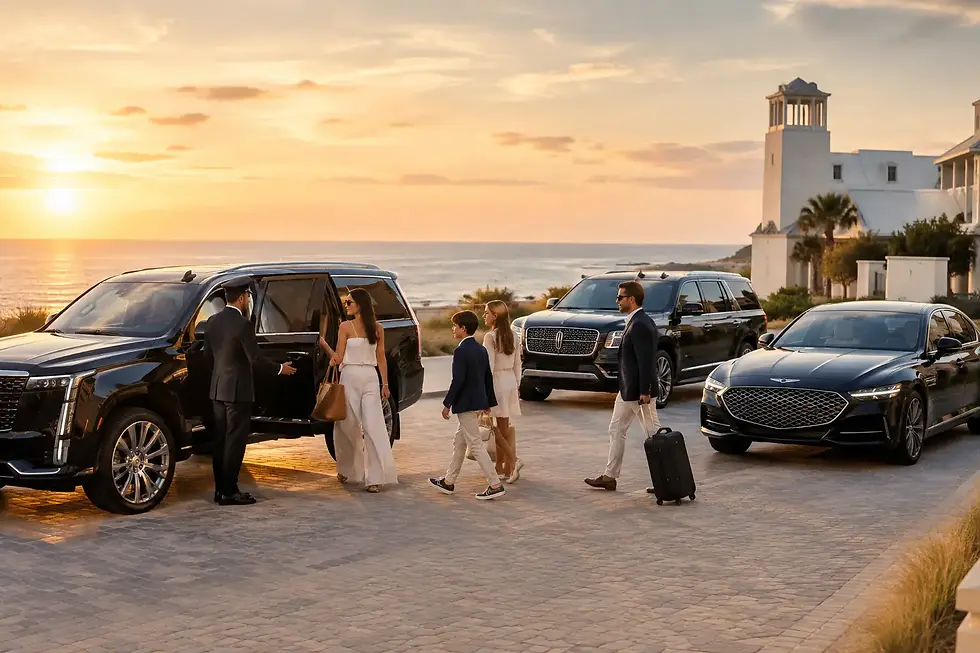
An SUV offers a different kind of ease. It provides more room for passengers, luggage, and the small practical items that tend to accompany a coastal stay: golf clubs, garment bags, strollers, beach gear, or the extra suitcases that come with traveling as a family. The added space can prevent the trip from beginning with compromises about what fits where.
Neither is inherently more thoughtful. A sedan favors calm intimacy. An SUV favors generous capacity. The right choice is the one that lets everyone settle in without negotiating for space.
When a sedan is the better airport transfer vehicle
A sedan is often the natural fit for a solo executive, a couple, or two travelers with standard checked luggage and carry-ons. It suits guests who value a quiet cabin, a polished presentation, and an unhurried drive after a flight. For an early departure from Rosemary Beach, Alys Beach, or Seaside, it can offer a particularly peaceful start to the day.
It is also a strong choice when the transfer itself is part of protected work time. A smaller, refined cabin can make it easier to review notes, answer messages, or simply decompress before arriving at a meeting, dinner, or residence. The experience feels intentional rather than oversized.
The trade-off is straightforward: luggage capacity is more limited. A sedan may be perfectly comfortable for two people, but it is not the place to discover that several large suitcases, a golf bag, or children’s equipment need more room than expected.
When an SUV makes more sense
An SUV is generally the more forgiving choice for families, groups of three or more, and travelers with substantial luggage. The extra cargo space matters, but so does the ability for each guest to travel without feeling compressed. After a delayed flight or a late-night arrival, that breathing room can change the tone of the entire transfer.
SUVs are especially practical for multigenerational trips, wedding weekends, and extended stays along the coast. A family may have car seats, a stroller, cooler bags, and several cases. A wedding guest may have formalwear that should not be folded into an already-full trunk. An SUV gives the chauffeur and guests more options before the vehicle ever leaves the airport.
More space does not mean a less refined experience. For many guests, the most polished decision is the vehicle that accommodates every person and every piece of luggage without a second thought.
Sedan versus SUV airport transport: what to consider
Passenger count is the first consideration, but it should not be the only one. Two adults traveling light may be entirely comfortable in a sedan. Two adults traveling with four large bags and golf equipment may not be. Similarly, three guests may fit in an SUV with room to spare, while four adults with full-size luggage may require a larger vehicle plan.
Luggage deserves an honest inventory. Consider checked bags, carry-ons, personal items, golf clubs, strollers, child seats, garment bags, and purchases made during the trip. Guests often estimate only the suitcases, then overlook the items that make a vehicle feel crowded. A professional reservation process should account for the full picture, not just the number of seats.
The length and purpose of the drive also matter. A short transfer may make either option feel equally appropriate. A longer journey from Pensacola or Destin-Fort Walton Beach Airport to a 30A residence gives comfort more time to matter. Travelers arriving after several connections may value the open cabin of an SUV. Others may prefer the enclosed calm of a sedan and the chance to reset in privacy.
Finally, think about the moment after arrival. If guests are heading directly to a dinner reservation, a site visit, or a welcome event, a sedan may match the tone of the occasion. If the first stop is a vacation home with children, provisions, and a week’s worth of belongings, an SUV often removes friction before it begins.
Airport logistics can change the answer
Vehicle selection is only one part of a well-managed airport transfer. Flight timing, terminal coordination, weather, and the time of day all shape the arrival experience. A vehicle that is technically large enough is not necessarily the right vehicle if the booking has not accounted for flight changes, pickup instructions, or the needs of the group.
This is where pre-arranged service has real value. With Elevate Luxury Car Service, the goal is not to place a vehicle at the curb and hope the details work themselves out. It is to understand the arrival plan in advance: the airport, the flight, the party size, the luggage profile, and the destination. That preparation gives the chauffeur a clear operating picture and gives guests fewer decisions to make after landing.
For an arrival into Northwest Florida Beaches International Airport, for example, a family traveling to WaterColor may need a different vehicle recommendation than two executives continuing to a meeting in Santa Rosa Beach. Both deserve the same calm coordination. Their space requirements simply differ.
Comfort is more than cabin size
A larger vehicle is not automatically more comfortable, and a smaller one is not automatically more elegant. Comfort comes from fit. It is the absence of bags at someone’s feet, the ability to enter and exit without rushing, and the quiet confidence that the chauffeur knows where to be and when to be there.
For couples, a sedan can feel like a private arrival. For a family, that same vehicle may feel restrictive before the drive has even begun. For a business traveler, an SUV may provide useful space for colleagues and equipment. For one person traveling alone, it may be more vehicle than the moment requires.
The most considered choice respects the actual journey, not an assumption about what a luxury airport transfer should look like.
A simple way to choose with confidence
Choose a sedan when the party is small, luggage is moderate, and a more intimate cabin suits the purpose of the trip. Choose an SUV when additional passengers, substantial luggage, children’s items, or extra personal space are part of the plan. If the details are close, favoring space is often the more relaxed decision, especially for an airport arrival.
There is no need to overthink the choice alone. Share the number of guests, the luggage count, and any special items when arranging the transfer. A careful recommendation is part of good hospitality, not an afterthought.
The best airport vehicle is the one that lets the doors close, the bags disappear from view, and everyone exhale on the way to where they are meant to be.


Comments